

How students are collaborating with University of Guelph for thesis research
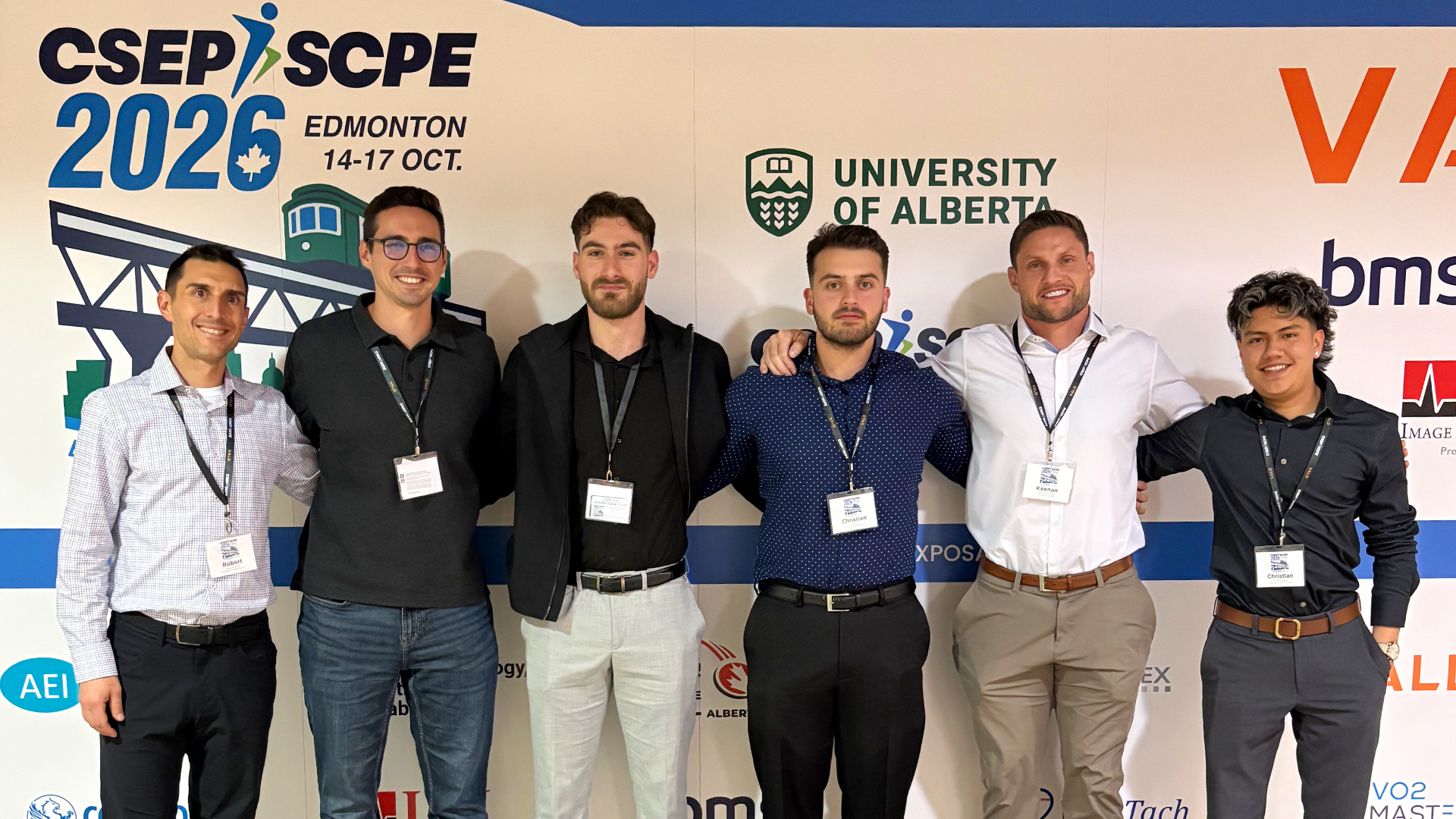
Above: 2026 CSEP Annual Conference in Edmonton, Alta.
How can athletes enhance their performance to lead their team to victory? This is a question a pair of Kinesiology students at the University of Guelph-Humber (U of GH) aim to answer through scientific research for their fourth-year thesis project.
Christian Matienzo and Christian Weisz are working with the Neuromechanical Performance Research Lab (also known as the “Power Lab”) at the University of Guelph, linking students to additional academic opportunities and valuable mentors.
"We developed our own research question and submitted our proposal to the Humber Research Ethics Board," Matienzo said of the work. "We're collecting data here [at U of GH] that we're going to analyze ...and hopefully get a published paper by the end of it."
Matienzo and Weisz’s research examines how light physical activity before a sports game can help athletes perform their best. For their research, athletes participate in a short session of light exercises a few hours before competing, then they measure their muscle activity through a tool called electromyography (EMG). So far, Matienzo and Weisz found this type of preparation can help activate muscles and improve athletes’ ability to produce force and power during the game.
They are also looking to recruit varsity basketball players from the Humber Hawks to participate in their study.
“If you were to participate in that specific exercise protocol six hours before game time, during your game, you're going to have a temporary enhancement in your power through measures including sprint speed, jumping, etc. So, our investigation is going to be an early study on discovering what mechanisms might be responsible for that effect,” Matienzo said.
To conduct this research, they worked with experienced mentors from the Power Lab – directly with University of Guelph associate professor Dr. Geoffrey A. Power and postdoctoral fellow Dr. Alex Zero, and also benefitted from the mentorship of postdoctoral fellow Dr. Keenan MacDougall.
“Dr. Power has been great. He provided us a lot of articles to read and a bunch of ideas and ways to improve our study. [He also gave] general feedback on our research writing,” Weisz said. He continued, “There are a bunch of great minds in [the Power Lab]. They don't just care about your academics; they also care about you on a personal level.”
Dr. Zero said that he has seen Matienzo and Weisz grow in their confidence, independence, critical thinking, and scientific communication since he began working with them in the lab. “It has been particularly rewarding to see the students develop a greater sense of ownership over their research and confidence in their abilities as young scientists,” he said.
As part of their studies, Matienzo and Weisz travelled to Edmonton, Alta., with Guelph-Humber Kinesiology Associate Head Dr. Robbie Gumieniak, Dr. Power, Dr. Zero, and Dr. MacDougall to attend the Canadian Society for Exercise Physiology (CSEP) Annual Conference in October. CSEP is a national organization that engages in knowledge translation, mentorship, and networking opportunities, and Dr. Gumieniak is a board member for the organization.
The students received financial support from Guelph-Humber Student Services and the Kinesiology program to attend the conference.
Here, they observed various presentations about research and developments in the exercise science field and networked with professionals from across Canada.
As an aspiring chiropractor, Matienzo received guidance about pursing this career path and furthering his education in graduate school. Weisz also made valuable connections and was inspired by the work ethic of the professionals he met there. Networking and observing the presentations also informed the work tied to their thesis.
“It gave me the opportunity to critically evaluate different study designs and taking away little bits and pieces from each presentation that I think might be able to help me with my own study design,” Matienzo said.
He added, “I think of research as like one big puzzle. Nobody knows the answer to everything… Everybody's working together to create a little piece to try and create a clearer image of something so that we can all create something [larger] together.”
Take the next step towards a future in movement and health. Explore the University of Guelph-Humber’s Kinesiology program here.