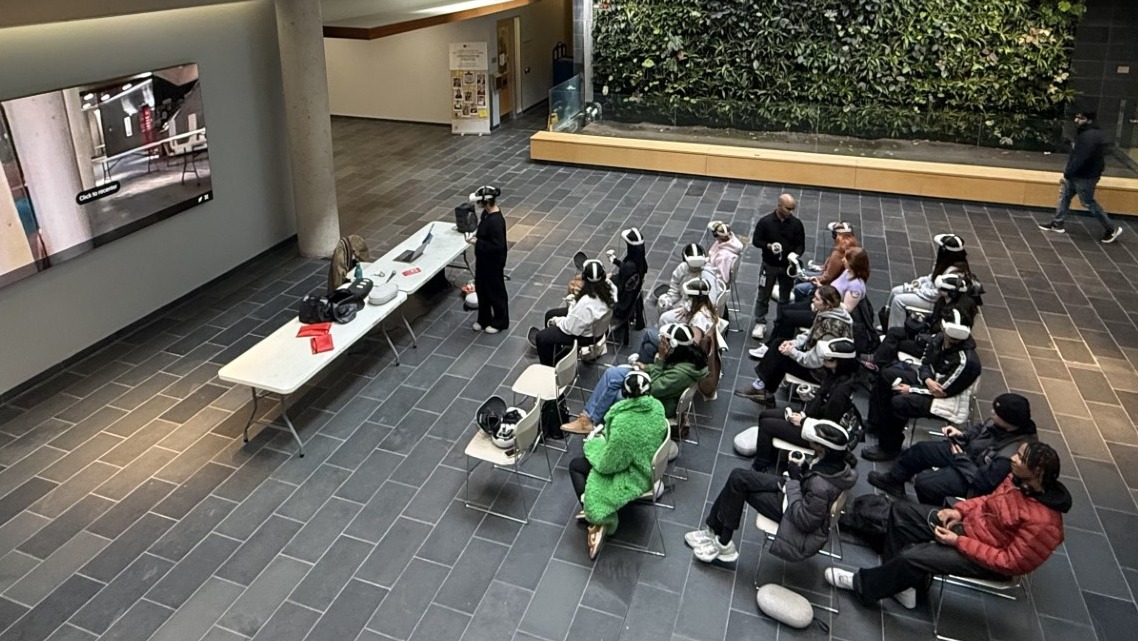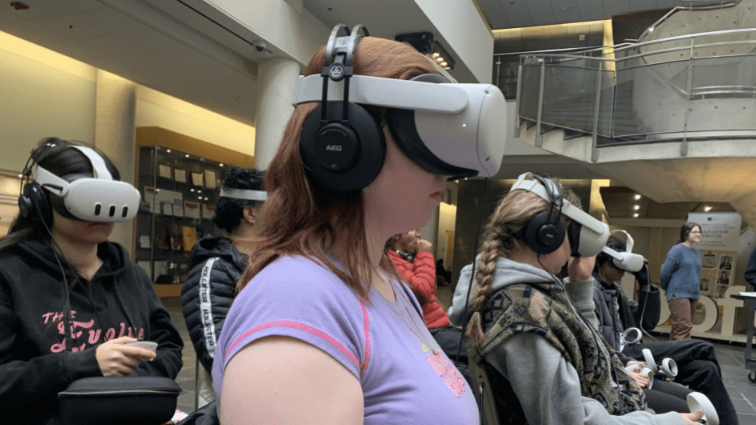
Headset on, reality altered.
Media & Communication Studies (MCS) students at the University of Guelph-Humber (U of GH) are learning to become immersive storytellers by leveraging the power of extended reality (XR).
XR is an umbrella term for immersive technologies. These technologies include virtual reality (VR), augmented reality (AR), and mixed reality (MR). VR fully replaces the real world with images and sounds experienced through a headset and headphones, AR superimposes generated elements over what the viewer perceives in the real world (for example, Pokémon Go), and MR allows digital elements to interact with the physical world.
A group of MCS students in instructor Tony Vieira’s Winter 2026 course New Worlds: Exploring XR (MDST*3360) created a short film project in VR called “Somnia – Do Students Dream of Overdue Sheep?” about experiencing school-related stress while asleep. This film featured 360-degree video that immersed viewers into a dream-like scenario while wearing a VR headset. In the experience, they were faced with the anxiety of technology glitching when trying to work on a school project. This allowed viewers to literally experience the story and associated feelings firsthand.
The group, comprising Sophia Barcellona, Shannon Coady, Valentina Mikhailov, and Avery Paterson, achieved a significant milestone when their project was selected and showcased at the Festival of International Virtual and Augmented Reality Stories (FIVARS) in Toronto.
For Coady, this demonstrated how the group was able to apply the theory they learned in practice, allowing her to gain an understanding about why certain approaches are taken when using XR to convey a story.
“There's a difference between what can be portrayed through a flat, normal video and a 360 [degree] video… You want to be effective in the way you're using the space to tell a story,” she said.
While this was her first time making a VR short film, Coady is no stranger to the VR headset. As an avid user who runs community events of the platform VRChat (a virtual world for people to connect with others), she was curious to learn more about the medium. The course allowed Coady to gain insights on how to use the technology to create content and how to edit 360-degree video and expand her storytelling skillsets, which can make her a standout in the workplace.
“[Viewers] remember meaningful experiences far more… understanding and experimenting with these different ways of telling stories gives students the tools to be able to throw themselves into something that is experience-related or immersive,” Vieira said. Vieira is also an XR and digital media creator. A bright mind in the field, his work has been shown internationally in Portugal and Norway in various festivals, and he is a member of the Electronic Literature Association (an international organization that explores novel ways of storytelling).
Moreover, students in the winter 2026 session of New Worlds: Exploring XR used GoPro MAX cameras, and Meta Quest 2 and Meta Quest 3 headsets. For editing, Coady said her group used Adobe Premiere Pro to edit their short film, Somnia.
While XR technologies aren’t fully mainstream yet, their usage is expanding as the world rapidly evolves, which is why students at U of GH are learning about effectively using it.
Learn more about the Media & Communication Studies program here.