

A look back at the founding of Guelph-Humber and the leader whose vision helped turn an idea into a thriving academic community
The University of Guelph-Humber (U of GH) is a place where theory meets hands-on learning, where everyone can belong and flourish, where beautiful study spaces bathed with sunlight exist, and the first step to launching successful careers.
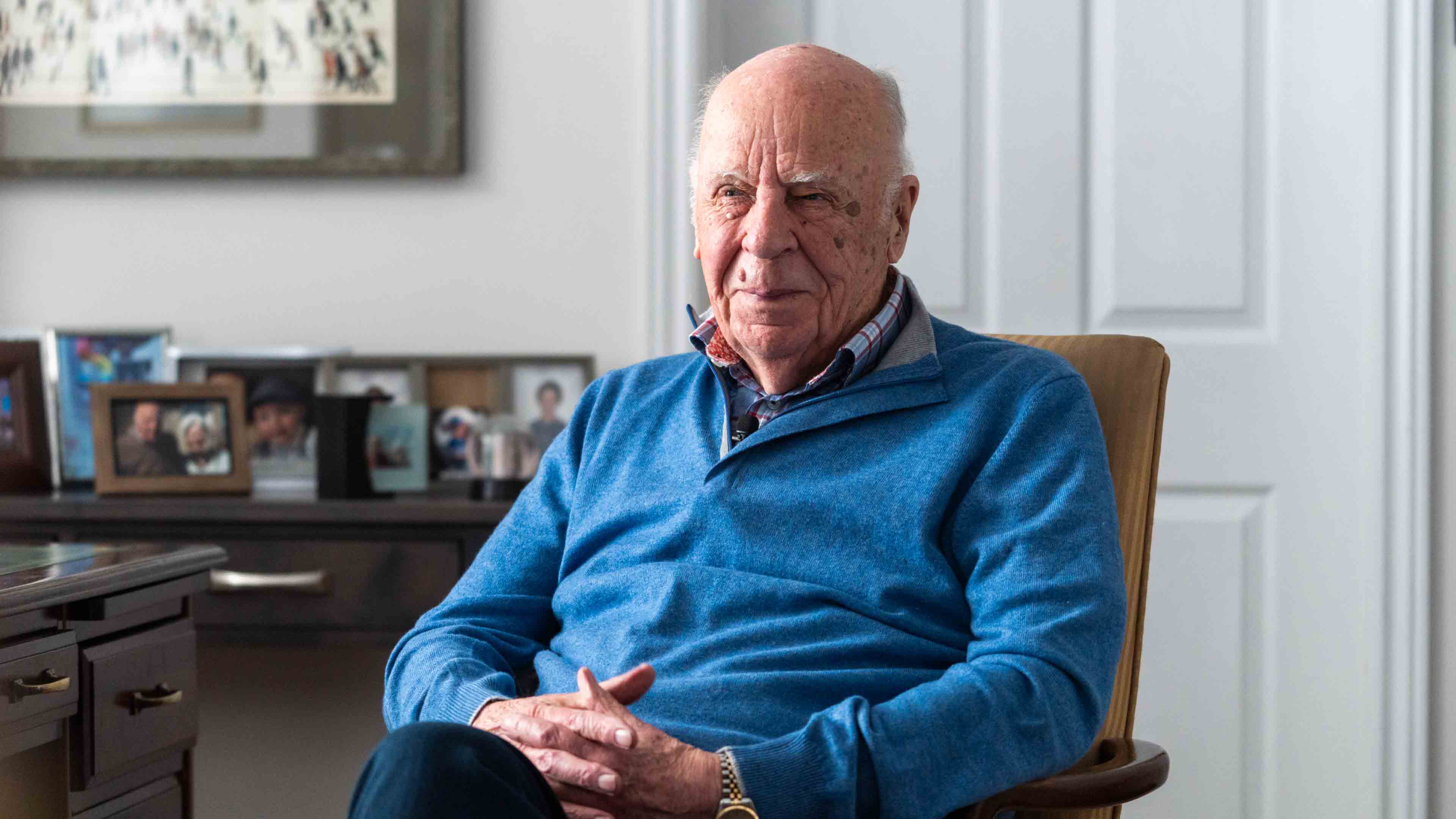
The University of Guelph-Humber may not have become the impactful institution we know today without Dr. Michael Nightingale – the University’s first vice-provost and chief academic officer from 2001 to 2005. A visionary in the post-secondary sector, Dr. Nightingale played a key role in the inception of the University, which was the first in Ontario to offer the opportunity to earn both an honours university degree and a college diploma within four years of full-time study, all in one location.
As U of GH approaches its 25th anniversary, we sat down with Dr. Nightingale to reflect on his life and journey through academia, and the enduring legacy he has left behind at the institution.
“I look forward to seeing Guelph-Humber moving from step to step for its future,” he said, adding to “be curious, a good listener, and do not resist change” when commenting on the important things he learned during his career.
He continued, “I hope now and in the future that the leadership of Guelph-Humber will listen to what is happening in the world and to young people, what their needs are for education and that they should focus on that. And if I ever should fall into the trap of saying it was better in the old days, they should not listen to me.”
Dr. Nightingale’s life and career have been anything but stagnant, marked by a deep commitment to the people and students he has served.
The early years of a lifelong learner
Born in 1935, his life began in the U.K. as the son of an Anglican preacher, which meant he and his family frequently moved during his childhood. As a child, he experienced the terrors of World War II. When the Nightingale family lived in Manchester in the early forties, he recalled enemy air raids and spending nights in an Anderson shelter, and one morning emerging to see the destruction of bombed homes nearby.
While he has now built an extraordinary career in academia, his journey was non-linear. The Nightingale family eventually relocated to Rochdale, which was the town Dr. Nightingale left as a young adult to move to London for college in 1953.
“I didn’t do well in high school. I attended a grammar school that measured their success by the number. So, it must have been a disappointment to my parents and teachers that I went to Westminster Technical College, the equivalent of community college,” he said. But this didn’t stop him from becoming a self-described lifelong learner. Over several years, he enrolled in full-time and part-time courses, ultimately earning graduate and honorary degrees.
At Westminster he completed a sandwich (co-op) program specializing in Hotel Operations, with placements in hotels in the London’s West-End and Ascot. After this, he joined the military to complete his National Service in the British Army, where after his basic training, he became a personal chef to a major general. He then went on to be a “stagiaire” (trainee) at the Hôtel Saint James et d’Albany in Paris. He returned to England and undertook management roles in the private and public sectors of hospitality before becoming a lecturer in hospitality at a Technical College in Manchester.
“I didn't realize it at the time, how my background in hospitality played such an important part in influencing my whole career, because the focus was always on the people you were serving,” Dr. Nightingale said when reflecting on his early education and career.
This breadth of experience led to his appointment as education officer of a professional association in hospitality and he subsequently succeeded his boss to become the senior executive of the organization. In this role, he was deeply engaged in an initiative to merge two professional associations, which was an experience he was able to draw upon twice more during his career.
Career changes
During this time, realizing the benefits many of his team members had gained from a university education, he did the unconventional and went back to school around the age of 40 to participate in the year-long Sloan Fellowship at the London Business School. This included field visits to Germany, Massachusetts, and Alberta (which was his first visit to Canada).
During the Sloan Program, he was challenged by a fellow student about standards in the hospitality industry, and why the professional association he led had so little impact. Always curious and up to a challenge, he decided to undertake an assignment to determine why the standards that he knew senior management aspired to attain did not always work out in practice. This generated buzz within the industry when Dr. Nightingale began to share his findings, which resulted in him establishing a consultancy advising companies on how to increase quality and productivity in the hospitality industry. Although most of his assignments were in the U.K., they did include some abroad in Europe, Africa, Asia and Australasia. To help ensure his advice kept up to date he successfully completed a graduate program at the University of Surrey as a part-time student. He also made time to share his knowledge and experience teaching with undergraduates.
One day, he received a call from the University of Guelph asking if he could recommend potential candidates for the position of director of the School of Hotel and Food Administration (now the School of Hospitality, Food & Tourism Management) – and they asked if he was interested. He served as the director of the hotel school from 1987 to 1995, where he launched a co-op program, a semester abroad on the French Riviera, and a graduate program.
He was later appointed to the role of dean at the University of Guelph’s College of Family and Consumer Studies, which subsequently merged with the College of Social Sciences to form the College of Social and Applied Human Sciences. As its founding dean, Dr. Nightingale gained further experience of bringing together two communities into a single team. This again furthered his experience in bringing the University of Guelph-Humber to fruition in the early 2000’s.
The genesis of Guelph-Humber
Dr. Nightingale’s beloved wife died when he was 65 years old. He had reached retirement age – but there was no slowing down. He was invited to lead a novel project to establish a new university in Toronto through a partnership between Humber College (now Humber Polytechnic) and the University of Guelph. This became the University of Guelph-Humber.
“I had experience of being a student in a community college and a university. I had experience of teaching in a community college and teaching at a university. I had experience of bringing different working communities together to form partnerships and to develop shared values,” Dr. Nightingale explained. “This was how I ended up at Guelph-Humber and continued in that role until I was 70."
Before the University opened its doors, Dr. Nightingale was active in planning the curriculum for the original six programs (Business, Computing [co-op], Early Childhood Studies, Family and Community Social Services, Justice Studies, and Media). Drawing on a practice of then-Humber College, the curriculum was expressed in learning outcomes, a new approach for the University of Guelph, but welcomed enthusiastically by the chairperson of the Board of Undergraduate Studies at the time. He also met regularly with the architect to ensure the building was designed to meet the learning outcomes of each program. At the core of this labour was serving the future students of the institution.
The first year U of GH opened its doors, there were just 200 students in three programs, with the remaining three original programs were introduced a year later. Though the first group was small, the most rewarding part for him was seeing that initial cohort graduate four years later – with the students receiving two credentials: a Humber diploma and a University of Guelph degree. At the same time, Dr. Nightingale received the same two credentials – honorary degrees from both institutions.
“This was one of my most memorable memories, apart from getting clearance by the fire marshal for students to move in to the new building, a day before classes started,” he said of the first convocation, laughing.
Dr. Nightingale said he is also grateful for the first cohort of students who were willing to “take a risk” and try a new kind of higher education program, for the initial team of staff and instructors “who were unusually extraordinary in respecting the contributions made by each of their colleagues,” and for the leadership of each partner institution as they embarked on this venture, seen as experimental at the time.
Today, Dr. Nightingale’s legacy is felt at U of GH through the beautiful plant wall (he wanted to bring a piece of University of Guelph in; it was inspired by research at the university for growing plants on Mars), the tight-knit community he helped shape, and the Michael Nightingale Community Enrichment Award. Each year, this award is given to one graduating student who has made significant contributions to the Guelph-Humber community, beyond their own program of study, and shares Dr. Nightingale’s commitment to enriching the student experience at the University. Since 2006, 20 students have received this honour.
Life beyond academia
Throughout his tenure, his vision and dedication were critical in shaping both the academic and co-curricular environments at Guelph-Humber. While Dr. Nightingale still enjoys being involved in the post-secondary sector when needed, he commits his time to a plethora of hobbies, and has served on several community boards in the City of Guelph.
Throughout his career in education, he has been asked to draw upon his experience of establishing Guelph-Humber through presentations and consultancy assignments, contributing to the establishment of new universities in Botswana, and Nunavut, Canada. He has also taught first-year seminars on poverty at the University of Guelph and courses in hospitality and tourism at Humber.
One of his current volunteer projects is to preserve the St. George’s Anglican Church archives, in conjunction with the Guelph Public Library – a project his late wife was once passionate about. He has been working on it for approximately three years. The church has been around for nearly 200 years, and he explained that it had an “enormous influence” on the City of Guelph’s development. The project entails moving these resources to a place accessible to researchers and properly stored in temperature-controlled facilities.
These days, Dr. Nightingale spends most of his time with his grandchildren, tending to his electric model train set as he’s had an affinity for trains since childhood, and cheering on his favourite European football team, Bolton Wanderers F.C. (he has been a fan since his teenage years). He also meets weekly with his “hasdeans group,” comprised of former University of Guelph deans, at a local pub to discuss the state of the world as it impacts education.
Thank you, Dr. Nightingale, for your lasting contributions to Guelph-Humber.
Related stories: