

U of GH Early Childhood Studies students learn about mindfulness through an Indigenous tradition during Foundational Theories and Practice class
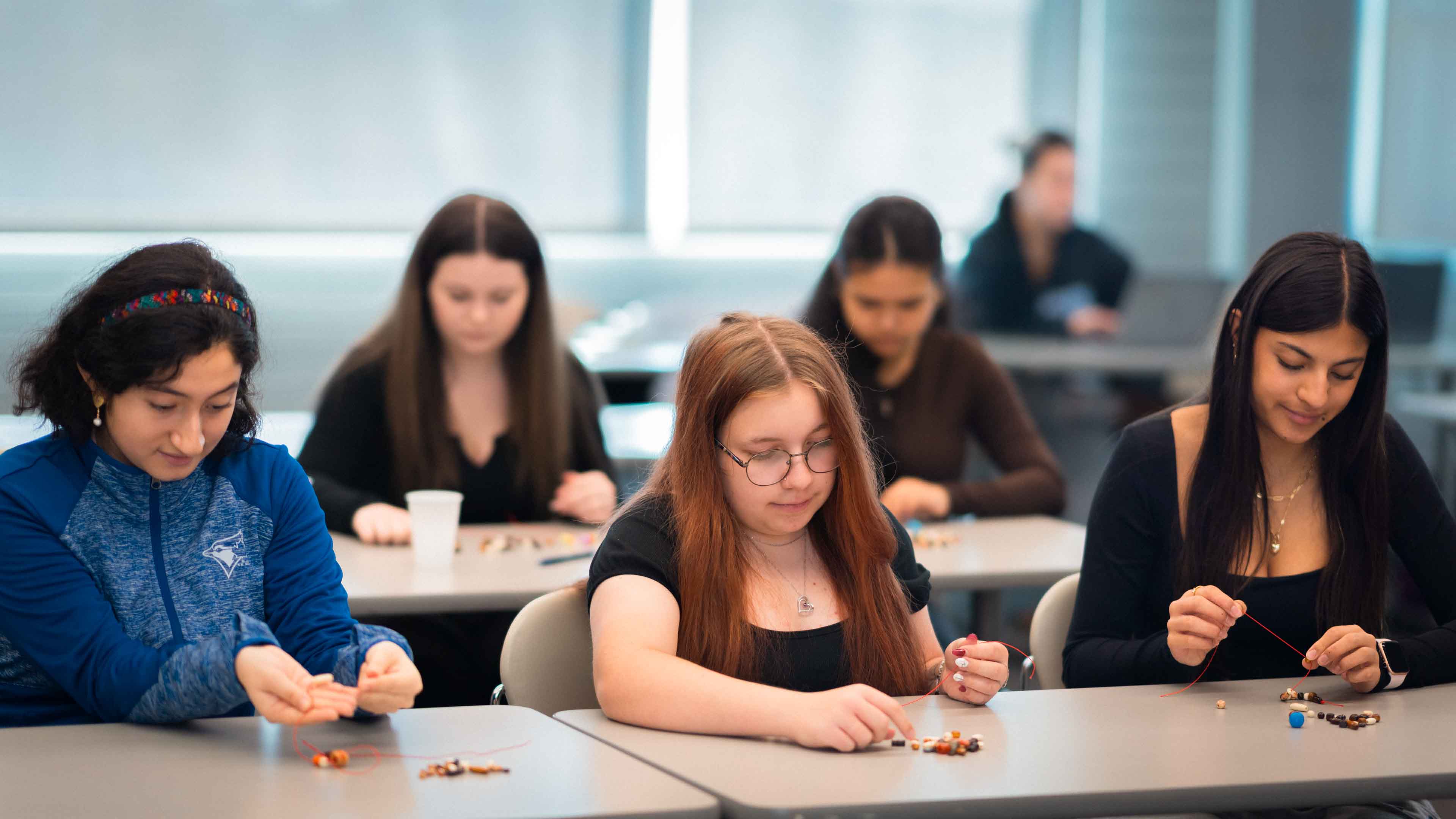
Throughout the fall 2025 semester, Early Childhood Studies (ECS) students at the University of Guelph-Humber (U of GH) participated in a mindfulness activity that’s rooted in Indigenous tradition – crafting knowledge necklaces. This is the first time students at U of GH engaged in this exercise, as the program expands its teachings on Indigenous Ways of Being, Knowing, and Doing.
First-year students in Hillary Pugh’s ECS*1000 Foundational Theories and Practice course created their own knowledges necklace during class, adding one bead each week. Maya-Rose Simon, Associate Head, Indigenous Early Childhood Education, ECS, explained that each bead symbolizes a moment of learning, growth, or connection, ultimately resulting in a visual representation of the learner’s journey. The students selected beads they felt represented their current mood or at another moment in time, based on colour, size, shape, and the feelings the beads evoked.
“This initiative was inspired by a desire to decolonize educational spaces and embed Indigenous knowledge systems that honour the whole person, body, heart, mind, and spirit,” Simon explained, who is Anishinaabeg from the Chippewa Tribe of Sault Ste. Marie, Mich. “I hope students come to see learning as a living, relational process, and leave with a deeper sense of knowing that is grounded in connection."
ECS student Kieran Duong said working on her knowledge necklace has become the best part of the week. Duong said the project is meaningful because it’s important to keep Indigenous traditions alive.
Moreover, Duong added that as a future early childhood professional, it’s key to understand Indigenous Ways of Being, Knowing, and Doing because U of GH graduates will likely come across Indigenous children during their career. With the devastating history of residential schools in Canada, Indigenous children should feel connected with their roots, and it’s integral that early childhood professionals understand that.
“We need to be more respectful in understanding Indigenous cultures and how they do things,” Duong said.
Course instructor Hillary Pugh said the knowledge necklaces align with Indigenous values of slowing down and taking in your relationships with the earth, plants and animals, and with each other, leaving room for observing, listening, and participating in connections that shape the world. For non-Indigenous members of the Guelph-Humber community, this mindset shift may involve approaching daily life with a deeper awareness of interconnection and reciprocity, which can be achieved through self-reflection – the type that could stem from creating a knowledge necklace.
ECS student Ana Velez-Alvarado said that building her knowledge necklace felt like “a reward” each time she came to class. Whenever she inserted a bead, throughout the stress of the daily grind, it has been a meaningful activity that made her smile.
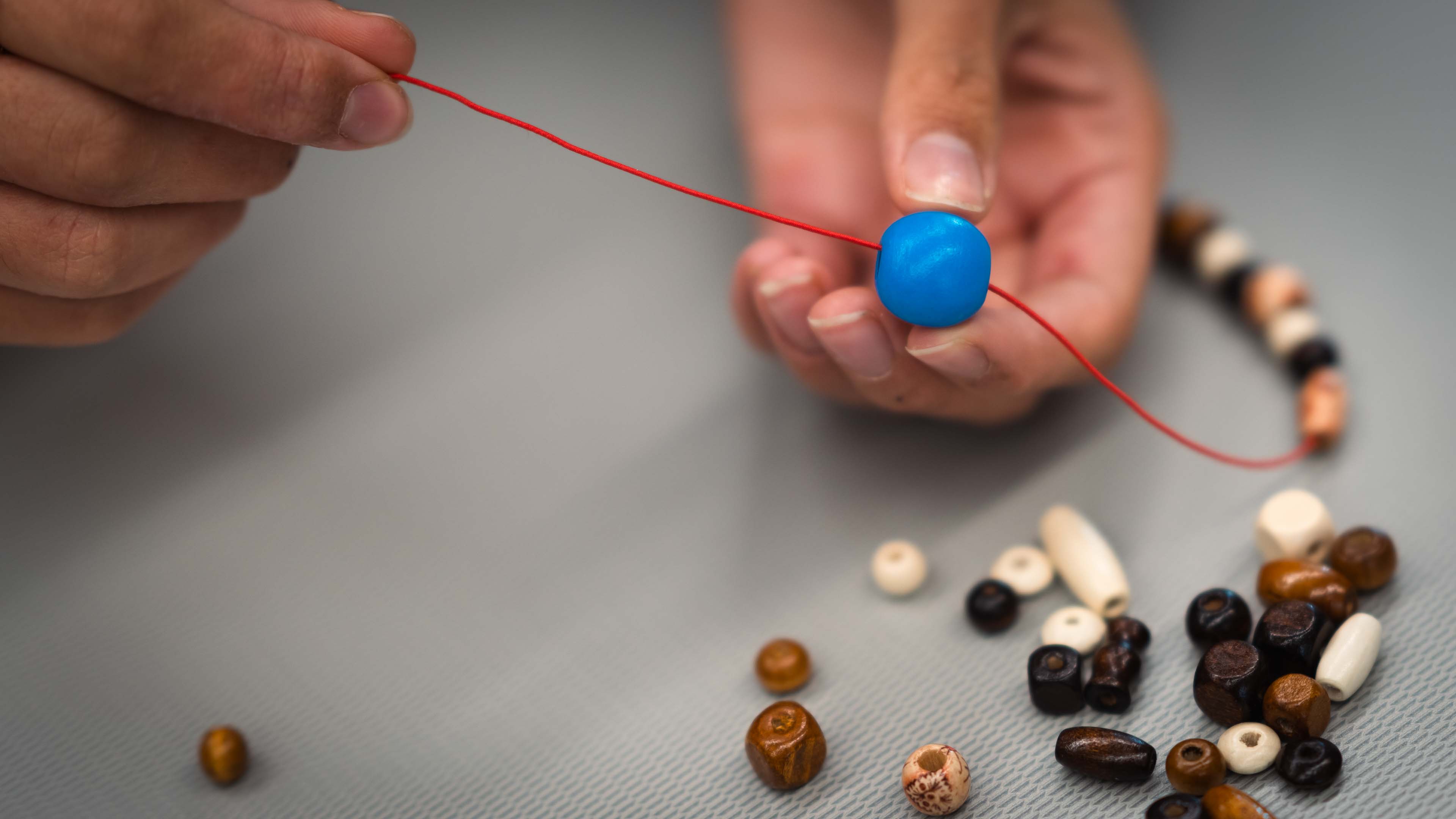
Each bead she has added to her project is unique. Pointing to a flat, rounded brown bead with a large hole in the centre that resembles a donut, Velez-Alvarado explained she selected that bead because of how centred she felt in the Guelph-Humber community at that moment. It was her first week of university at U of GH, and she felt connected with her peers and instructors. Another long, pink bead she used represents happiness. Pink is her favourite colour, and like her time as a student at Guelph-Humber, pink sparks joy.
When looking around the classroom at her peers’ knowledge necklaces, she noticed no two look alike. Each interpretation is different, and that showed her how everyone’s experiences are unique.
“My focus [for the class] is universal design for learning, making sure that everyone is feeling included, and feels that they're being supported through a learning journey specific to this area of early childhood, knowing every student is bringing their own personal experience to the classroom with them,” Pugh explained in her effort to allow each student in her class to feel seen.
Working on the project alongside her classmates gave Velez-Alvarado a sense of unity – with her peers and her instructor. The practice also allows Velez-Alvarado to explore her creativity, while balancing academics.
“Creativity is something that you should hold on to throughout your life,” she said. “Cherish that.”
And when the knowledge necklace is complete, the students will be able to look back and reflect on their educational journey during their first semester of the ECS program at U of GH – a tactile reminder of what they learned in the classroom and about themselves, and all they’ve overcome.
Interested in exploring Guelph-Humber’s ECS program and participating in initiatives like this? Click here to learn more.