

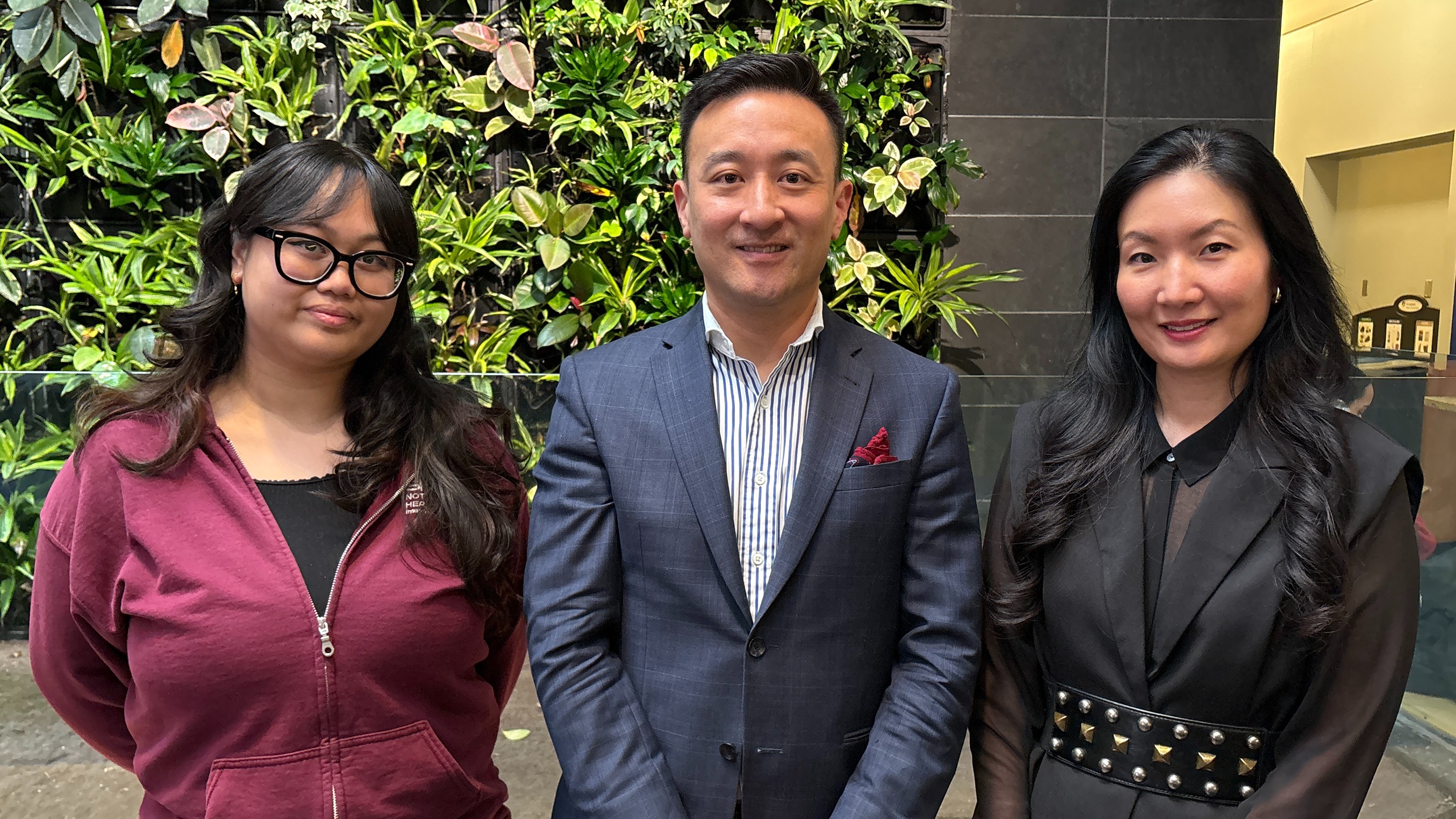
Pictured above: Second-year student Hannah Grace Acacio, Dr. John Lee, Psychology Chair Dr. Alice Kim
Psychology students at the University of Guelph-Humber (U of GH) experienced an insightful keynote address during the 2026 U of GH Psychology Conference on campus: “Financial Psychology 101: Money, Stress, and Student Life” by Dr. John Lee.
This keynote presentation provided students with financial literacy knowledge that they could apply to their daily lives through the academic lens of psychological theory.
Second-year Psychology student Hannah Grace Acacio was at the presentation, where she expanded her thinking and reflected on her relationship with money. Here’s what she had to say about her experience:
Q: What sparked your interest in attending Dr. John Lee’s keynote presentation, Financial Psychology 101: Money, Stress, and Student Life?
A: My decision to attend Dr. John Lee’s keynote, Financial Psychology 101: Money, Stress, and Student Life, was motivated by my interest to broaden my knowledge about finances. As a Psychology student with a focus on clinical or medical career pathways, finance is not a topic I typically acknowledge in my studies. Because of this gap in my knowledge, I believed that attending Dr. Lee’s keynote presentation would be a great foundation to begin learning about investing, budgeting, and how to be more strategic and intentional with my money.
Q: What was your top educational takeaway from the presentation?
A: The smartest thing you can do with your money is to be intentional with it, whether that would be through investing, budgeting, or monitoring your net worth. Regarding investing, Dr. Lee spoke about how to grow your wealth and that it might be smart to take advantage of uncertainty, try to invest consistently, and develop your money long-term. Pertaining to budgeting, Dr. Lee addressed the importance of keeping track of how you split your income – identifying your wants, needs, and saving goals. Lastly with net worth, Dr. Lee highlighted the importance of monitoring your net worth – keeping track of your income and liabilities.
Q: How will you apply what you learned from Dr. Lee’s presentation in your daily life?
A: Dr. Lee’s keynote address has inspired me to begin investing my money and thinking about my wealth long-term. Since listening to his presentation, I have been doing my own research on types of investments, like stocks and exchange-traded funds (ETF), and account types, like Tax-Free Savings Accounts (TFSA) and First Home Savings Accounts (FHSA). Being introduced to these concepts taught me that students like myself should take a proactive approach to their finances, as investing early provides a significant advantage in obtaining financial freedom.
Q: Do you feel what you learned during this presentation will change your relationship with money?
A: Dr. Lee has broadened my perspective on money and motivated me to strive for financial freedom. Growing up with a similar Asian cultural background and values to Dr. Lee, I found myself personally connecting with his initial beliefs about money. After listening to the presentation, I have gained the confidence to make more informed financial decisions and take calculated risks.
Q: What coping strategies were discussed that you think are realistic for students?
A: Financial stress is a burden many students struggle with. Because of this, Dr. Lee discussed several realistic coping strategies for students. Two notable examples were budgeting and seeking a trusted source for financial information. Budgeting is a fantastic way to keep track of expenses like tuition, academic materials, residential fees, etc. Keeping track of these expenses can eliminate any surprises and allows students to strategize with their money. Having a trusted source for financial information allows students to continue to learn about how to grow their wealth without gaining false or inaccurate information.
Q: In your view, generally, why is learning about financial psychology important, especially as a young adult?
A: Financial psychology educates students on the best strategic methods on how to manage your finances. I have learned that investing consistently with a long-term commitment as early as possible is an amazing and smart way to grow your wealth, which is an opportunity that young adults, like myself, have.
Q: What does hosting a session like this say about Guelph-Humber's commitment to student well-being and real-world education?
A: Hosting Dr. John Lee’s keynote session, Financial Psychology 101: Money, Stress, and Student Life, highlights Guelph-Humber’s commitment to student well-being and real- world education. Financial literacy is an essential skill that benefits students throughout their academic journeys and beyond. By recognizing students’ financial well- being and real-world knowledge, Guelph-Humber demonstrates that it is not only a place for academic growth, but also an environment where students develop lifelong skills significant across all areas of their lives.
Explore the University of Guelph-Humber’s Psychology program here.