

Dallas Lockhart, Kaitland Waind, Rachel Balintec presented at the Teaching and Learning Innovations Conference 2026
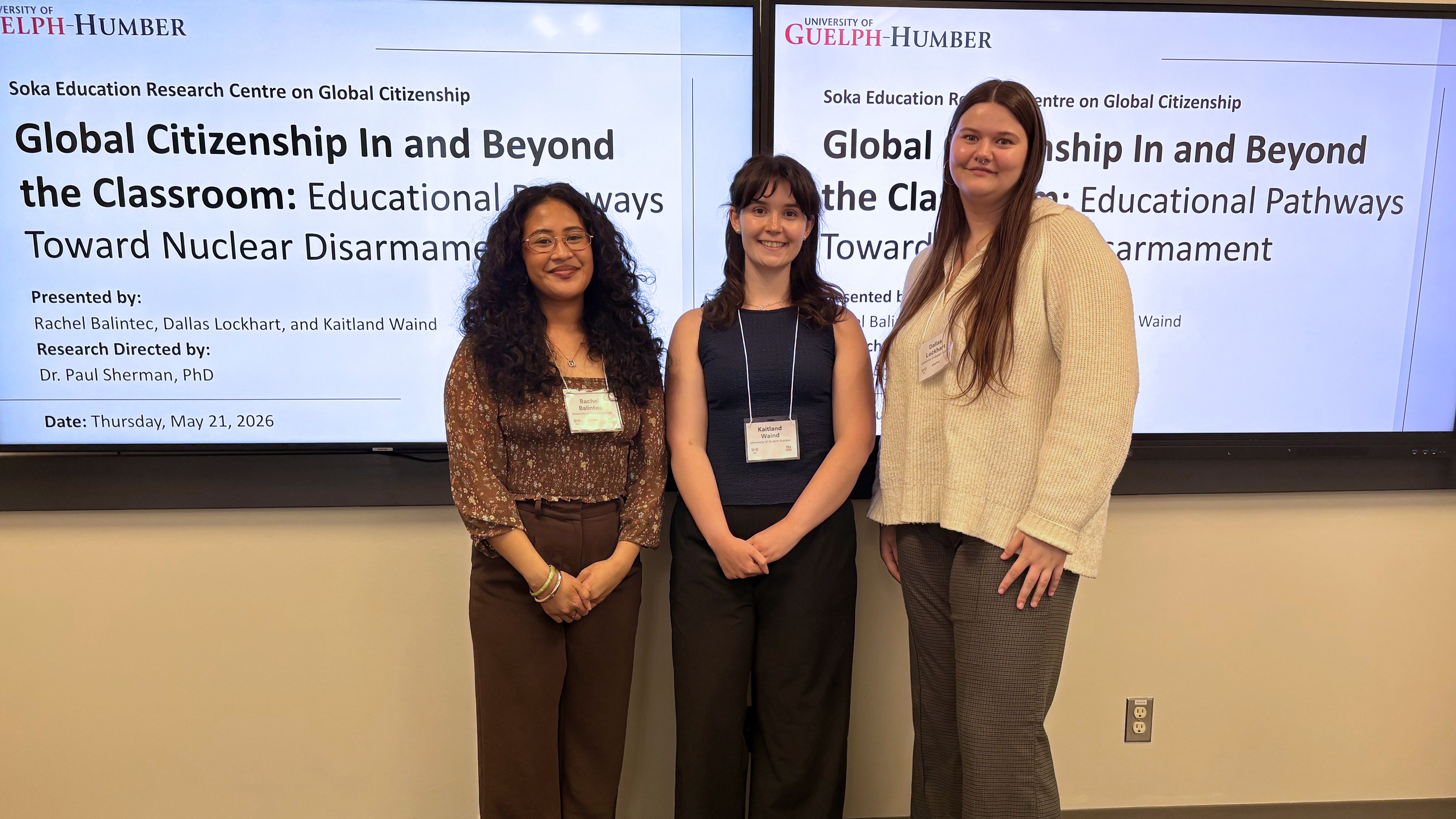
A group of University of Guelph-Humber (U of GH) students presented original research at the Teaching and Learning Innovations Conference 2026 at the University of Guelph to an audience comprising educators, researchers, staff, and students – a unique opportunity for undergraduate students at Guelph-Humber.
Community Social Services students Dallas Lockhart (fourth year), Kaitland Waind (third year), and Rachel Balintec (a fourth year who served as group leader on the project) shared their research, “Global Citizenship in and Beyond the Classroom: Educational Pathways Towards Nuclear Disarmament,” which was about how education can be used as a tool to help students learn about peacemaking efforts and nuclear disarmament advocacy.
At U of GH, there are ample opportunities for undergraduate research and scholarly activities through thesis courses in various programs, independent studies, or in this case, through the Soka Education Research Centre on Global Citizenship (SERC-GC).
“In this project, we wanted to frame learning as something that's collaborative and relational, something that's rooted in Soka education values and principles, which includes global citizenship,” Balintec said of the principles of value creation, peacekeeping, and uniting as a global community. “We wanted to incorporate that into classroom learning and curriculum and pedagogy within modern learning, and how we can create educational settings where nuclear disarmament and peacemaking efforts are at the core of what all students are being taught.”
Balintec explained that the research examined how applying Soka education principles like shared dialogue, critical reflection, and humanistic learning approaches help students personally connect with complex global issues in ways that support peacemaking and nuclear disarmament education. Rather than positioning this issue as one that’s solely political or governmental, this approach to integrating peacemaking within educational contexts encourages students to develop compassion, critical awareness, empathy, and a sense of shared responsibility that empowers them to see themselves as contributors to peacebuilding, she said.
This work built upon prior research that the SERC-GC research assistants (including Balintec, Lockhart, and Waind) completed during the 2025-2026 academic year, under the supervision of SERC-GC director, Dr. Paul Sherman. It had analyzed what nuclear disarmament can look like in cross-cultural contexts by reviewing the efforts of Canada, the United States, Sweden, and Japan. During the academic year, they also set up an exhibit on nuclear disarmament in the Guelph-Humber art gallery called “Everything You Treasure: For A World Free From Nuclear Weapons,” which was provided by Soka Gakkai International (SGI), an NGO in consultative status with the United Nations that strives to strengthen connections among individuals, civil society, and the UN. Here, they had guests of the exhibit fill out a questionnaire before and after experiencing it to gauge their attitudes and opinions on nuclear disarmament – and they observed guests left with a strong anti-nuclear sentiment.
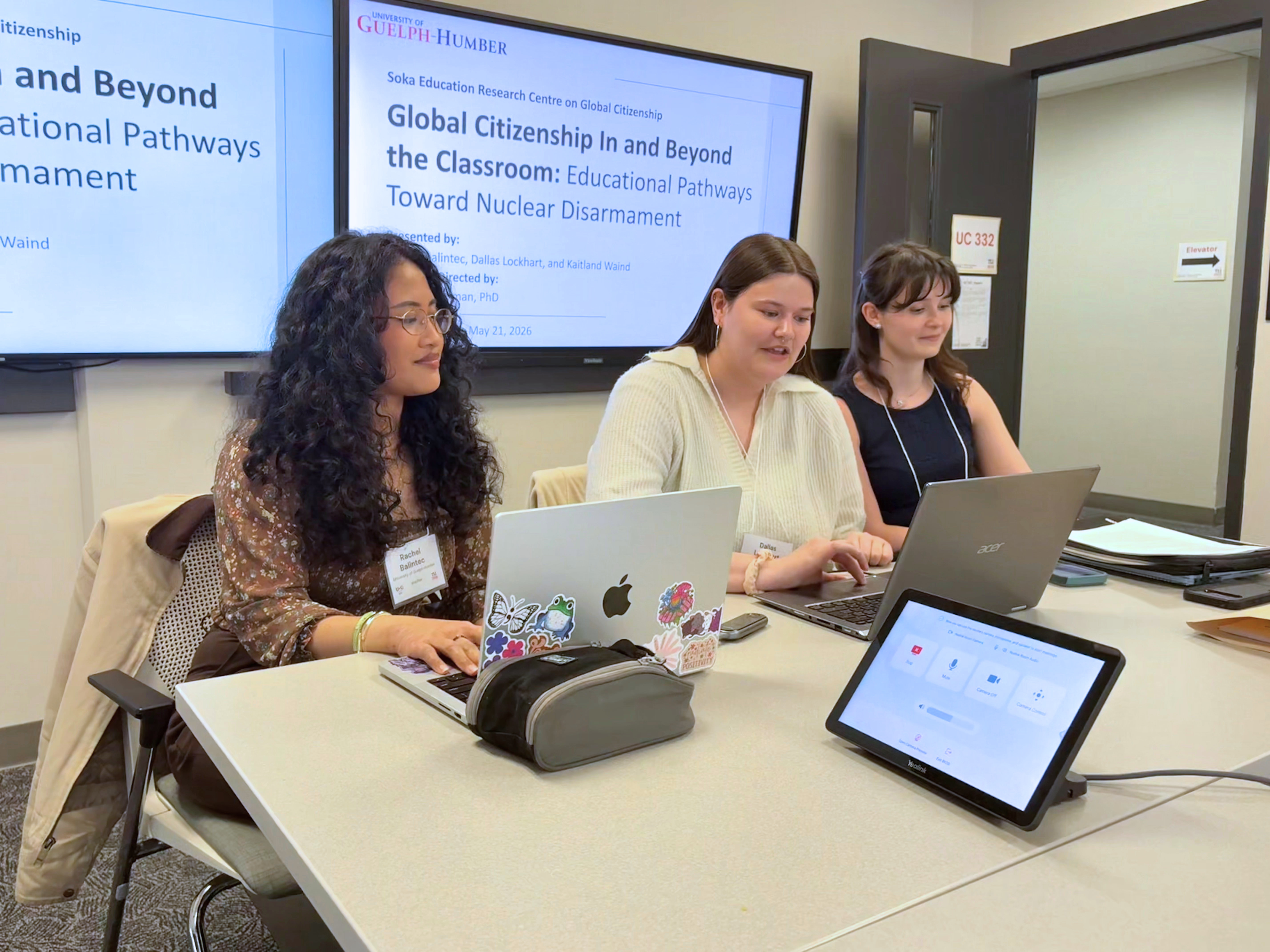
Moreover, the latest research, presented under the conference’s “Self Actualization and Growth" stream, fit in well with this year’s conference theme, “Conditions for Learning,” inspired by Maslow’s Hierarchy of Needs, a psychological theory that suggests human behaviour is driven by five essential requirements. Balintec explained their research on nuclear disarmament reflects the basic need for safety, as well as self-actualization (growth and fulfillment) that can be reached when there is peace in the world.
Furthermore, the research itself allowed Balintec to feel a sense of passion for the work and growth in her skillsets, preparing her for further research in a master’s program and possibly a PhD program one day.
“As an undergraduate student, I think starting [to conduct research] early has been so empowering and has allowed us to come together to discover more parts of ourselves that we might not have even known before,” she said.
The conference also served as a valuable networking opportunity for the students. Balintec said she met PhD students from the University of Guelph in similar social services fields and asked them about their educational paths. She also reconnected with her former U of GH instructor, Dr. Nitin Deckha, who observed their presentation.
“It was such a pleasure meeting new faces and reconnecting with old ones who inspired me in the past. It felt like a full circle moment where I was able to connect with mentors who helped me get to where I am today,” she said.
Moreover, Balintec added that while it was “a little bit intimidating at first” to present to a room full of educators, the experience ultimately empowered and inspired her.
“[The conference was] bringing teacher and student voices together to ensure that we can share our experiences on what we find [in the research], and learning how students can thrive in educational environments,” she said. “It inspired me to continue working towards this peace pursuit.”
Learn more about research opportunities and scholarly activities at the University of Guelph-Humber here.